Quick Overview
- If you have ever thought, “Why is IGCSE Physics so hard?”, you are definitely not alone. Physics can feel challenging because it asks you to do several things at once. You need to understand the concept, choose the correct equation, work with units, interpret graphs or diagrams, and explain your answer clearly.
- In Cambridge IGCSE Physics 0625, students study topics ranging from forces and energy to thermal physics, waves, electricity, magnetism, nuclear physics and space physics.
- Cambridge does not officially rank these topics from easiest to hardest. However, some areas can become particularly challenging because they involve several connected ideas or require both calculation and explanation.
In this article, we will look at five topics that are worth giving extra attention to:
- Forces and Motion
- Thermal Physics
- Waves
- Electricity and Circuits
- Magnetism and Electromagnetism
Quick Facts
| Topic | Details |
| Subject | Cambridge IGCSE Physics |
| Syllabus Code | 0625 |
| Levels | Core and Supplement |
| Syllabus Reference | 2026–2028 |
| Main Areas | Motion, Forces, Energy, Thermal Physics, Waves, Electricity, Magnetism, Nuclear Physics and Space Physics |
| Key Skills | Conceptual understanding, calculations, graph interpretation, practical skills and scientific explanation |
| Is there an official hardest topic? | No. Cambridge does not rank topics by difficulty |
– Why Does IGCSE Physics Feel So Hard? ▶
– What Are the Hardest Topics in IGCSE Physics? ▶
– Forces and Motion ▶
– Thermal Physics ▶
– Waves ▶
– Electricity and Circuits ▶
– Magnetism and Electromagnetism ▶
– Why Physics Questions Feel Harder Than the Formula ▶
– How to Improve Your IGCSE Physics ▶
– FAQ: Why Is IGCSE Physics Hard? ▶
Why Does IGCSE Physics Feel So Hard?
One reason Physics can feel harder than some other subjects is that learning a formula is only the beginning.
In many questions, you need to decide:
- which concept is being tested
- which equation is relevant
- which quantities need converting
- how to interpret a graph or diagram
- how to explain the physics behind the result
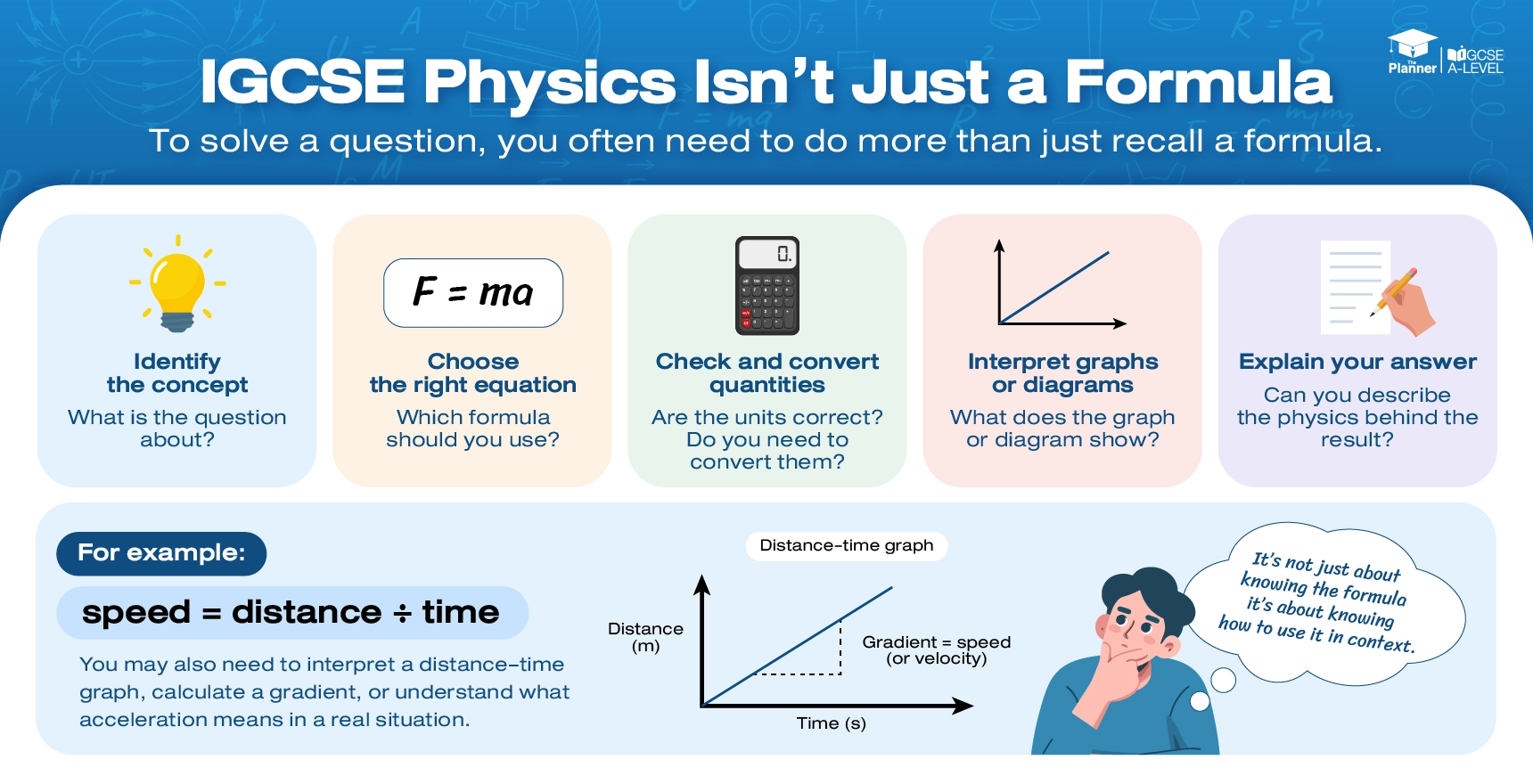
For example, knowing the equation
speed = distance ÷ time
does not automatically mean every motion question will be easy.
You may also need to interpret a distance–time graph, calculate a gradient or understand what acceleration means in a real situation.
The official Cambridge IGCSE Physics 0625 syllabus places a strong emphasis on understanding basic physical principles, applying them in different situations and developing practical scientific skills.
What Are the Hardest Topics in IGCSE Physics?
There is no single hardest topic for every student. Some students find calculations difficult, while others struggle more with explanations or diagrams.
However, these five areas are good ones to monitor closely because they combine several different skills.
| Topic | Why Students May Find It Difficult |
| Forces & Motion | Combines equations, graphs, direction and physical interpretation |
| Thermal Physics | Requires understanding what particles are doing, not just memorising definitions |
| Waves | Includes diagrams, wave properties and different types of waves |
| Electricity & Circuits | Requires both circuit understanding and equation use |
| Magnetism & Electromagnetism | Involves direction, fields and several connected concepts |
So, maybe the best way to improve your grade is to notice what type of IGCSE Physics question do I keep losing marks on?
1. Forces and Motion
Forces and Motion is one of the first major areas in IGCSE Physics, but it can quickly become more complicated than it first appears.
Students may need to work with:
- speed
- velocity
- acceleration
- distance–time graphs
- speed–time graphs
- resultant forces
- mass and weight
- moments
- momentum
Why Forces and Motion Can Be Difficult
A common challenge is that the same question may involve both calculation and interpretation.
For example, on a speed–time graph, you may need to know that:
- the gradient represents acceleration
- the area under the graph represents distance travelled
You also need to pay close attention to direction.
A resultant force is not always found by simply adding numbers together.
Cambridge Examiner Reports have highlighted mistakes where candidates added forces instead of subtracting them, and some students also misunderstood what happens when forces are balanced.
Balanced forces do not necessarily mean an object stops.
They mean there is no resultant force, so an object may continue moving at constant velocity.
How to Improve
Ask yourself what is acting on the object? Then check:
- What direction is each force acting?
- Are the forces balanced or unbalanced?
- Which equation is relevant?
- Do any units need converting?
For graph questions, learn the meaning of both the gradient and the area under the graph, rather than memorising individual examples.
2. Thermal Physics
Thermal Physics can be confusing because students sometimes memorise words such as conduction, convection and radiation without fully understanding what is happening physically.
Topics may include:
- particle model of matter
- temperature
- thermal expansion
- conduction
- convection
- thermal radiation
- specific heat capacity
- changes of state
Why Thermal Physics Can Be Difficult
Many questions ask you to explain rather than calculate.
For example, why does a vacuum reduce thermal energy transfer? To answer well, you need to connect the idea back to particles. A vacuum contains no particles, so thermal transfer by conduction and convection cannot take place through the vacuum.
Examiner Reports have shown that questions about thermal transfer can be challenging when students give vague answers instead of explaining what happens to particles or energy.
How to Improve
Do not memorise isolated definitions. Instead, link every process to what the particles are doing.
For example:
Conduction → particle collisions and energy transfer
Convection → movement of warmer, less dense fluid
Radiation → transfer by infrared radiation
If you can explain the process in your own words, the exam questions become much easier.
3. Waves
Waves can look simple at first because the basic equation is straightforward:
wave speed = frequency × wavelength
But the topic includes much more than one formula.
You may study:
- wavelength
- frequency
- amplitude
- wave speed
- reflection
- refraction
- diffraction
- sound
- electromagnetic spectrum
Why Waves Can Be Difficult
Students often mix up basic terms such as:
- wavelength
- amplitude
- frequency
Another challenge is knowing how waves behave when they move from one situation to another.
For example, you may need to explain changes in direction during refraction or compare different parts of the electromagnetic spectrum.
Cambridge Examiner Reports have noted that some candidates did not label wave properties precisely enough, particularly amplitude and wavelength.
How to Improve
Make sure you can draw and label a wave from memory.
You should be able to point to:
- wavelength
- amplitude
- crest
- trough
Then practise linking diagrams to equations.
A good revision order is:
Wave Structure → Wave Equation → Reflection & Refraction → Electromagnetic Spectrum
4. Electricity and Circuits
Electricity is often one of the topics where students know the equations but still find exam questions difficult.
Topics may include:
- current
- potential difference
- resistance
- electrical power
- electrical energy
- series circuits
- parallel circuits
- electrical safety
- electricity transmission
Why Electricity Can Be Difficult
There are several quantities and equations that look similar.
For example:
V = IR
P = IV
E = Pt
Students need to know what each symbol represents and which equation matches the information given.
Circuit questions can also become difficult when you need to understand what changes in a series or parallel circuit.
Cambridge Examiner Reports have also identified difficulties with electricity generation and transmission, including understanding why high voltages are used to reduce energy loss in cables.
How to Improve
Do not memorise equations as separate pieces of information.
Create a relationship between the quantities:
Current → Charge Flow
Potential Difference → Energy Transfer per Charge
Resistance → Opposition to Current
Then practise reading circuit diagrams before calculating anything. And then ask what stays the same? What is shared? What changes?
5. Magnetism and Electromagnetism
Magnetism can feel difficult because many questions involve direction.
Students may need to understand:
- magnetic fields
- electromagnets
- force on a current-carrying conductor
- electromagnetic induction
- generators
- transformers
Why Magnetism and Electromagnetism Can Be Difficult
There are several linked ideas that students sometimes mix together.
For example:
Electric current can produce a magnetic field
But
changing magnetic fields can also induce a potential difference
These are related ideas, but they are not the same process.
Direction questions can make the topic feel even harder because students need to understand what the field, current and force are doing at the same time.
How to Improve
Learn the topic as a sequence rather than as separate facts:
Current → Magnetic Field → Force
then
Changing Magnetic Field → Induced Potential Difference
Once you understand the relationship between each stage, generator and transformer questions become easier to follow.
Why Physics Questions Feel Harder Than the Formula
One of the biggest mistakes students make is assuming Physics revision means memorising equations.
Equations are important, but exam questions often test whether you can apply them in an unfamiliar situation.
For example, you might know:
density = mass ÷ volume
but the question may give mass in grams and volume in cubic metres.
Now the challenge is not the equation. The challenge is recognising that the units must be converted before calculating. Cambridge Examiner Reports regularly highlight issues such as incorrect unit conversions, rearranging equations incorrectly and giving explanations that are not precise enough.
This is why good Physics revision should include:
Concept → Equation → Units → Application → Explanation
How to Improve Your IGCSE Physics
If Physics feels difficult, do not try to revise the entire syllabus again from the beginning.
Use your mistakes to decide what to work on.
Step 1: Find Your Weak Topic
Complete a mixed-topic test or Past Paper. Then look at the questions you lost marks on.
Separate your mistakes into categories:
- Concept
- Equation
- Unit conversion
- Graph
- Explanation
- Practical question
Step 2: Understand the Concept First
Before memorising an equation, make sure you understand what is physically happening.
For example, do not just memorise:
F = ma
Make sure you understand that a resultant force causes acceleration.
Step 3: Connect the Equation to the Concept
Once the concept is clear, learn the equation and what each quantity means.
Then practise rearranging it.
Step 4: Practise Topic Questions
Do several questions on the same topic until you can identify the method without being told which equation to use.
Step 5: Move to Past Papers
Finally, complete full Past Papers so you learn how to switch between topics under exam conditions.
If IGCSE Physics still feels difficult even after doing lots of practice questions,
At The Planner Education, we can help students identify weak topics, rebuild the underlying concepts and practise exam-style questions step by step for Cambridge IGCSE Physics.



What Should You Do If You Understand the Lesson but Cannot Answer Exam Questions?
This is very common in Physics. Understanding a lesson and answering an exam question are two different skills.
If this happens, try practising in this order:
Concept → Simple Calculation → Diagram/Graph → Explanation → Multi-step Exam Question
This gives you time to build each skill before combining everything in a full Past Paper.
FAQ: Why Is IGCSE Physics Hard?
1. Why is IGCSE Physics so hard?
Answer:
IGCSE Physics can feel difficult because students need to combine conceptual understanding, equations, unit conversions, graphs, diagrams and scientific explanations.
2. What is the hardest topic in IGCSE Physics?
Answer:
There is no single hardest topic for every student, and Cambridge does not officially rank topics by difficulty. Forces, Thermal Physics, Waves, Electricity and Electromagnetism can all become challenging because they involve several connected skills.
3. Is IGCSE Physics harder than IGCSE Maths?
Answer:
They test different skills. IGCSE Maths focuses heavily on mathematical reasoning and problem solving, while Physics requires students to apply mathematics to physical concepts and explain scientific ideas.
4. Is IGCSE Physics mostly calculations?
Answer:
No. Calculations are important, but students also need to interpret graphs and diagrams, explain physical processes and understand practical investigations.
5. Do I need to memorise all IGCSE Physics equations?
Answer:
Students need to know how to use the equations required by the syllabus, but understanding what each quantity represents and when to use an equation is just as important.
6. Why are IGCSE Physics electricity questions difficult?
Answer:
Electricity questions often involve several related quantities, such as current, voltage, resistance, power and energy, as well as understanding circuit behaviour.
7. Why is Thermal Physics difficult?
Answer:
Thermal Physics requires students to explain energy transfer using particle behaviour, so memorising definitions alone is often not enough.
8. How can I improve at IGCSE Physics?
Answer:
Identify your weak topics, understand the concept first, practise equations and units, complete topic questions and then move on to full Past Papers.
9. Are Past Papers enough for IGCSE Physics?
Answer:
Past Papers are very useful, but if you do not understand the underlying concept, repeatedly doing exam questions may lead to the same mistakes.
10. How do I stop making calculation mistakes in Physics?
Answer:
Write down the equation first, convert units before substituting values and check whether your final answer is physically reasonable.
11. How should I revise IGCSE Physics before an exam?
Answer:
Focus first on weak concepts, then practise topic questions and finally complete full Past Papers under timed conditions.
12. Where can I find official IGCSE Physics resources?
Answer:
The official Cambridge IGCSE Physics 0625 page provides the syllabus and links to Cambridge teaching and learning resources.
References
- Cambridge International Education — Cambridge IGCSE Physics (0625), Syllabus 2026–2028
Use this as the main reference for syllabus content, subject aims, Core/Supplement coverage, assessment objectives, and practical skills.
- Cambridge International Education — Past Papers, Examiner Reports and Specimen Papers for IGCSE Physics 0625
Use this as supporting evidence for common exam mistakes, question types, and examiner feedback.