Quick Overview
- There is no single answer for What are the hardest topics in IGCSE Maths that applies to every student.
- Cambridge International does not officially rank topics from easiest to hardest, and what feels difficult will depend on your individual strengths and weaknesses.
- Some areas in Cambridge IGCSE Mathematics 0580, especially at Extended level, often require students to combine several skills at once.
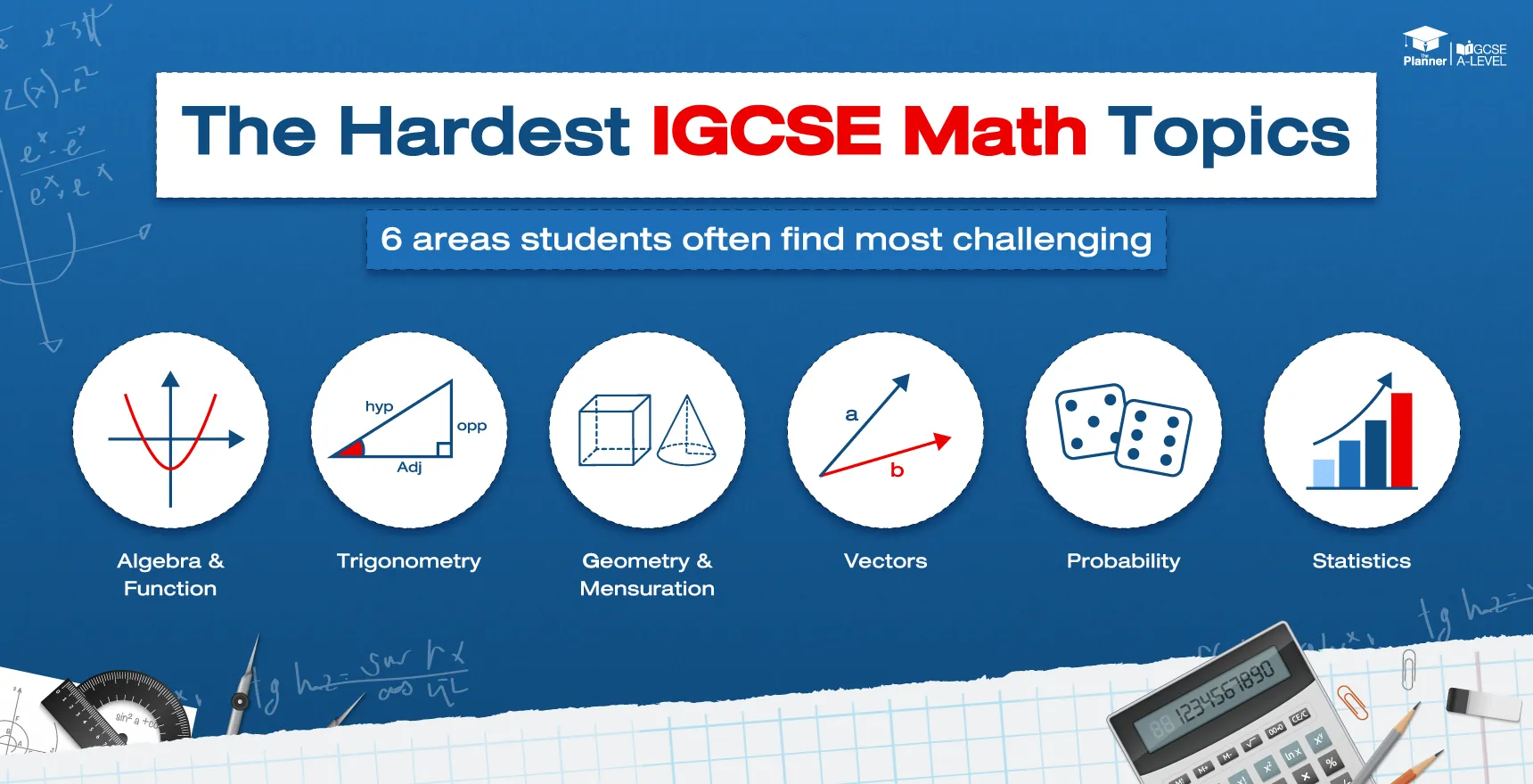
- Topics such as Algebra and Functions, Trigonometry, Geometry and Mensuration, Vectors, Probability and Statistics can therefore take more time and practice to master.
- The key is not simply to find the “hardest” chapter. It is to identify where you are losing marks and why.
Quick Facts
| Topic | Details |
| Subject | Cambridge IGCSE Mathematics |
| Syllabus Code | 0580 |
| Levels | Core and Extended |
| Syllabus Reference | 2025–2027 |
| Main Areas | Number, Algebra, Coordinate Geometry, Geometry, Mensuration, Trigonometry, Vectors & Transformations, Probability and Statistics |
| Key Skills | Mathematical techniques, reasoning, analysis and problem solving |
| Is there an official hardest topic? | No. Cambridge does not officially rank topics by difficulty. |
– Is IGCSE Maths difficult? ▶
– What are the hardest topics in IGCSE Maths? ▶
– Algebra and Functions ▶
– Trigonometry ▶
– Geometry and Mensuration ▶
– Vectors and Transformations ▶
– Probability ▶
– Statistics ▶
– Accuracy, Bounds and Surds ▶
– Why do IGCSE Maths Extended questions feel difficult? ▶
– How should you revise difficult topics? ▶
– FAQ on What Are the Hardest Topics in IGCSE Maths? ▶
Is IGCSE Maths Difficult?
IGCSE Maths can feel challenging, but the level of difficulty depends on your foundation and whether you are studying Core or Extended Mathematics.
One reason students sometimes find IGCSE Maths difficult is that the exam is not only about remembering formulas.
You are also expected to:
- apply mathematical techniques correctly
- recognise relationships and patterns
- use logical reasoning
- solve problems in unfamiliar situations
- show clear mathematical working
- interpret your final answer
This means that even if you know a formula, you still need to decide when and how to use it.
For some questions, the most difficult part is not the calculation itself. It is working out what the question is asking you to do.
What Are the Hardest Topics in IGCSE Maths?
There is no official list of the hardest topics in IGCSE Maths, as every student has different strengths.
However, some topics tend to require more steps, stronger foundations or a combination of several skills.
| Topic | Why Students May Find It Difficult |
| Algebra & Functions | Requires strong algebra skills and an understanding of how functions work |
| Trigonometry | Students must choose the correct method based on the diagram and information given |
| Geometry & Mensuration | Questions can combine several formulas and require strong visual understanding |
| Vectors & Transformations | Requires understanding of direction, position and geometric relationships |
| Probability | Multi-step questions can involve several events or diagrams |
| Statistics | Students must interpret data as well as calculate answers |
| Accuracy, Bounds & Surds | Small numerical mistakes can easily affect the final answer |
So, maybe the best way is to notice which topics are costing you the most marks to begin your revision.
1. Algebra and Functions
Algebra is one of the most important foundations in IGCSE Maths because it appears in many other areas of the syllabus.
If your algebra is not secure, you may also find topics such as Functions, Graphs and Coordinate Geometry more difficult.
Typical Algebra and Functions skills include:
- simplifying expressions
- solving equations
- rearranging formulas
- working with functions
- composite functions
- inverse functions
Functions can feel especially unfamiliar because you need to understand both the notation and the relationship between input and output.
Why Algebra and Functions Can Be Difficult
The main issue is that one mistake early in your working can affect every step that follows.
For example, if you rearrange an equation incorrectly, your final answer may still look reasonable even though the method has gone wrong.
How to Improve
Try revising in this order:
Basic Algebra → Equations → Functions → Multi-step Questions
Do not rush into difficult exam questions if you are still making mistakes with basic algebraic manipulation. Strong fundamentals will make the harder questions much more manageable.
2. Trigonometry
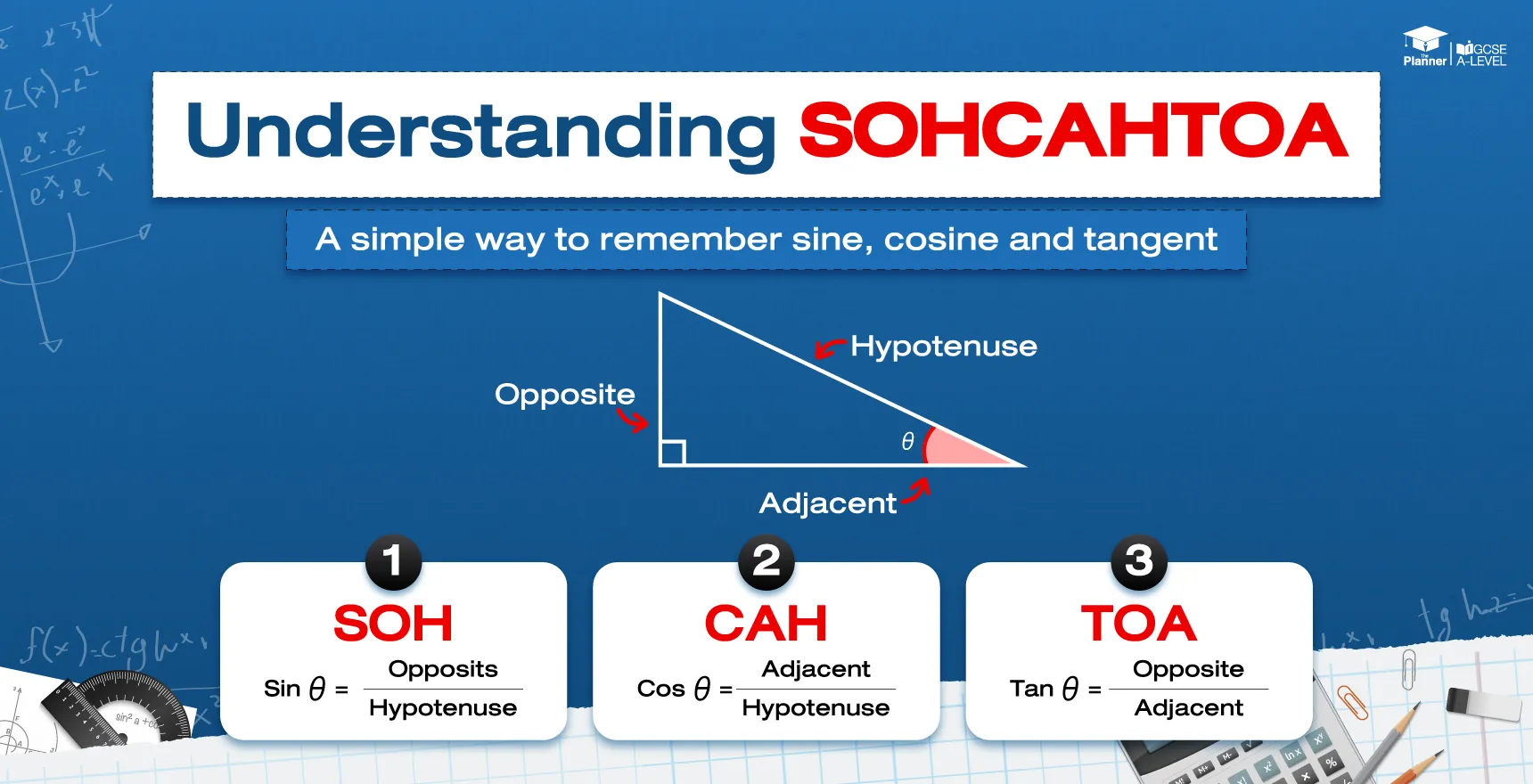
Trigonometry is another topic that often feels difficult because knowing the formulas is only one part of the process. You also need to recognise which method is suitable for the question.
Topics may include:
- right-angled trigonometry
- sine rule
- cosine rule
- area of a triangle
- bearings
- three-dimensional trigonometry
A common mistake is choosing a formula too quickly without checking the information in the diagram first.
Why Trigonometry Can Be Difficult
A question may require you to:
- understand the diagram
- identify the values you know
- decide what you are trying to find
- choose the correct formula
- calculate accurately
That is why Trigonometry can feel much harder than simply memorising SOHCAHTOA.
How to Improve
Before using any formula, ask yourself:
What do I know?
What do I need to find?
What type of triangle is this?
For Bearings and 3D Trigonometry, drawing or labelling the diagram clearly is especially helpful.
3. Geometry and Mensuration
Geometry and Mensuration involve much more than remembering area and volume formulas.
Exam questions often combine different shapes or ask you to find one missing measurement before you can calculate the final answer.
You may need to work with:
- angles
- circles
- similarity
- perimeter and area
- surface area
- volume
- compound shapes
Why Geometry and Mensuration Can Be Difficult
Many questions are multi-step questions. For example, you may need to find a missing length first, then use that value to calculate an area or volume. If the first step is incorrect, the rest of your solution can also go wrong.
How to Improve
Before calculating anything, label the diagram with:
- known lengths
- known angles
- units
- the value you need to find
4. Vectors and Transformations
Vectors can feel unfamiliar because they require you to think about both magnitude and direction.
Unlike many basic calculation questions, vector problems often involve relationships between several points in a diagram.
You may need to:
- write vectors in terms of other vectors
- follow different routes between points
- use geometric relationships
- simplify vector expressions
Why Vectors Can Be Difficult
The challenge is usually understanding the diagram rather than performing the arithmetic.
If you lose track of the direction of a vector, the signs in your answer can quickly become incorrect.
How to Improve
Always ask yourself:
Where does this vector start, and where does it end?
Drawing arrows and checking the direction before writing your expression can make vector questions much clearer.
5. Probability
Basic probability can be straightforward, but the topic becomes more challenging when several events are involved.
You may come across:
- tree diagrams
- Venn diagrams
- combined events
- conditional information
- repeated events
Why Probability Can Be Difficult
Students often understand the calculation but misread the relationship between events.
For example, you need to recognise whether the question involves:
- AND
- OR
- NOT
Choosing the wrong relationship can lead to the wrong calculation even if your arithmetic is correct.
How to Improve
Before calculating, write down what each event represents. For more complicated questions, drawing a tree diagram or Venn diagram can help organise the information clearly.
6. Statistics
Statistics requires both calculation and interpretation.
Depending on the question, you may need to work with:
- averages
- tables and charts
- cumulative frequency
- histograms
- scatter diagrams
Why Statistics Can Be Difficult
Students sometimes focus only on the calculation and forget to read the graph carefully.
A small mistake with the scale, axis or class interval can affect the whole answer.
How to Improve
Whenever you see a graph, check these three things before doing anything else:
Axis → Scale → Units
Then read the question carefully to see whether you need to calculate, estimate or interpret the data.
7. Accuracy, Bounds and Surds
Accuracy, Bounds and Surds may not be the longest topics in the syllabus, but they can be easy places to lose marks.
You may need to work with:
- upper and lower bounds
- decimal places
- significant figures
- exact values
- simplifying surds
Why These Topics Can Be Difficult
The mathematics itself may not always be complicated, but the questions require careful attention to detail.
For example, rounding too early during a multi-step calculation can change your final answer.
How to Improve
Keep as many digits as possible during your working and round only when the question asks you to.
For Bounds questions, make sure you understand whether you are looking for an upper bound or lower bound before substituting values.
Why Do IGCSE Maths Extended Questions Feel Difficult?
One of the biggest reasons Extended questions can feel difficult is that a single question may combine several topics.
For example: Geometry → Trigonometry → Area → Accuracy
Each individual skill may be familiar, but you need to recognise how they connect. This is why practising only isolated textbook exercises is not always enough. Once your foundation is secure, you should also practise questions that combine several topics together.
How Should You Revise Difficult IGCSE Maths Topics?
If you have several weak topics, you do not need to restart the entire syllabus.
A more effective approach is to revise strategically.
Step 1: Identify Your Weak Topics
Complete a Past Paper or mixed-topic test and look at where you are losing marks.
- Which topics do I keep getting wrong?
- Are the mistakes caused by weak concepts?
- Am I choosing the wrong method?
- Am I making calculation mistakes?
Step 2: Review the Concept
If you do not understand the method, doing more Past Papers is unlikely to solve the problem. Go back to the concept and make sure you understand why the method works.
Step 3: Practise Topic Questions
Once you understand the concept, practise several questions from the same topic. This helps you recognise different ways the same skill can appear in an exam.
Step 4: Return to Full Past Papers
Finally, practise full papers under timed conditions. This helps you build confidence in switching between topics and choosing the correct method without being told which chapter the question comes from.
If you are preparing for IGCSE Maths and certain topics are still holding your score back,
At The Planner Education, we can help identify your weak topics, review the concepts you need most and build a focused study plan for both IGCSE Maths Core and Extended.


Should You Start With the Hardest Topic First?
Not always, because some difficult topics rely on skills from earlier chapters. For example, Algebra to Functions and Geometry to Trigonometry.
If your foundation is weak, jumping straight into the hardest questions may make revision feel even more frustrating. A better approach is to work backwards and strengthen the prerequisite skills first. Once those foundations are secure, the more advanced topic often becomes much easier.
FAQ: Hardest Topics in IGCSE Maths
1. What is the hardest topic in IGCSE Maths?
Answer:
There is no single hardest topic for every student, and Cambridge does not officially rank topics by difficulty. However, Algebra, Functions, Trigonometry, Geometry, Vectors and Probability often require several steps or strong foundational skills.
2. Is IGCSE Maths difficult?
Answer:
IGCSE Maths can be challenging because the exam tests more than calculation. Students need to apply mathematical techniques, reason logically and solve problems in different contexts.
3. Is IGCSE Maths Extended difficult?
Answer:
Extended Mathematics covers more content and additional skills compared with Core. Students therefore need a strong foundation and enough practice with multi-step questions.
4. What are the main topics in IGCSE Maths?
Answer:
Main areas include Number, Algebra, Coordinate Geometry, Geometry, Mensuration, Trigonometry, Vectors and Transformations, Probability and Statistics.
5. Is Algebra difficult in IGCSE Maths?
Answer:
Algebra can be difficult if your basic manipulation skills are not secure because it connects with many other topics, including Functions, Graphs and Coordinate Geometry.
6. Why is IGCSE Trigonometry difficult?
Answer:
Trigonometry requires students to understand the diagram, identify the information given and choose the correct method rather than simply memorising formulas.
7. Are Vectors difficult in IGCSE Maths?
Answer:
Vectors can feel difficult at first because students need to understand direction and relationships between points as well as perform calculations.
8. How can I improve my IGCSE Maths score?
Answer:
Start by identifying your weak topics, review the underlying concepts, practise topic-based questions and then return to full Past Papers under timed conditions.
9. Should I memorise formulas for IGCSE Maths?
Answer:
Knowing formulas is useful, but you also need to understand when and how to apply them because many exam questions assess reasoning and problem solving.
10. How should I revise difficult IGCSE Maths topics?
Answer:
Break each difficult topic into smaller skills, review the concept, practise several questions of the same type and record any mistakes that you repeat.
11. Are Past Papers important for IGCSE Maths?
Answer:
Yes. Past Papers help you become familiar with exam-style questions, practise combining several topics and improve your timing.
12. Where can I find IGCSE Maths Past Papers?
Answer:
Past Papers, specimen papers and examiner reports for Cambridge IGCSE Mathematics 0580 are available through Cambridge International.