Quick Overview
- Cambridge International does not officially rank Mathematics topics from easiest to hardest.
- What feels challenging will depend on your mathematical foundation, the route you are studying and the types of questions you are most comfortable with.
- However, some topics in Cambridge International AS & A Level Mathematics 9709 require students to connect several mathematical skills at once.
- The important thing is not simply knowing which topics are considered difficult. It is understanding why you are losing marks and which prerequisite skills you need to strengthen first.
These include:
- Integration
- Differential Equations
- Complex Numbers
- Vectors
- Mechanics
- Probability & Statistics
Quick Facts
| Topic | Details |
| Subject | Cambridge International AS & A Level Mathematics |
| Syllabus Code | 9709 |
| Syllabus Reference | 2026–2027 |
| Pure Mathematics | Papers 1, 2 and 3 |
| Applied Mathematics | Mechanics and/or Probability & Statistics, depending on route |
| A Level Pure Papers | Pure Mathematics 1 and Pure Mathematics 3 |
| Main Skills | Logical thinking, mathematical modelling, accuracy, analysis and problem solving |
| Is there an official hardest topic? | No. Cambridge does not officially rank topics by difficulty. |

– Why Does A Level Maths Feel Hard? ▶
– What Are the Hardest A Level Maths Topics? ▶
– Integration ▶
– Differential Equations ▶
– Complex Numbers ▶
– Vectors ▶
– Mechanics ▶
– Probability & Statistics ▶
– Why Multi-Step A Level Maths Questions Feel Difficult ▶
– How to Improve Your A Level Maths ▶
– FAQ: Hardest A Level Maths Topics ▶
Why Does A Level Maths Feel Hard?
A Level Maths can feel like a big jump because questions increasingly test your ability to connect mathematical ideas, rather than simply apply one method at a time. Knowing a formula or technique is often only the first step.
In a single question, you may need to:
- recognise which topic is being tested
- rearrange an expression
- select the correct method
- connect ideas from an earlier topic
- complete several calculation steps accurately
- interpret whether your final answer makes sense
Cambridge International A Level Mathematics develops skills including logical and independent thinking, mathematical modelling, accuracy and analysing results.
This means that strong A Level Maths performance comes from understanding how different ideas work together, not simply memorising procedures.
What Are the Hardest A Level Maths Topics?
There is no official list of the hardest A Level Maths topics. However, certain areas can require more practice because they build heavily on earlier mathematical skills.
| Topic | Why Students May Find It Difficult |
| Integration | Requires recognising which integration technique is appropriate |
| Differential Equations | Combines algebra, integration and modelling |
| Complex Numbers | Introduces a new number system and geometric interpretation |
| Vectors | Requires strong spatial reasoning and careful algebra |
| Mechanics | Applies Mathematics to physical situations and diagrams |
| Probability & Statistics | Requires choosing the correct model and interpreting probability carefully |
Some of these topics appear specifically in Pure Mathematics 3, while Mechanics and Probability & Statistics depend on the A Level route being studied.
1. Integration
Integration is one of the areas where A Level Maths becomes noticeably more demanding.
At an earlier stage, you may be used to straightforward integration questions.
At A Level, you may need to work with:
- integration of more complicated functions
- integration by substitution
- integration by parts
- partial fractions
- definite integrals
- applications of integration
Why Integration Can Be Difficult
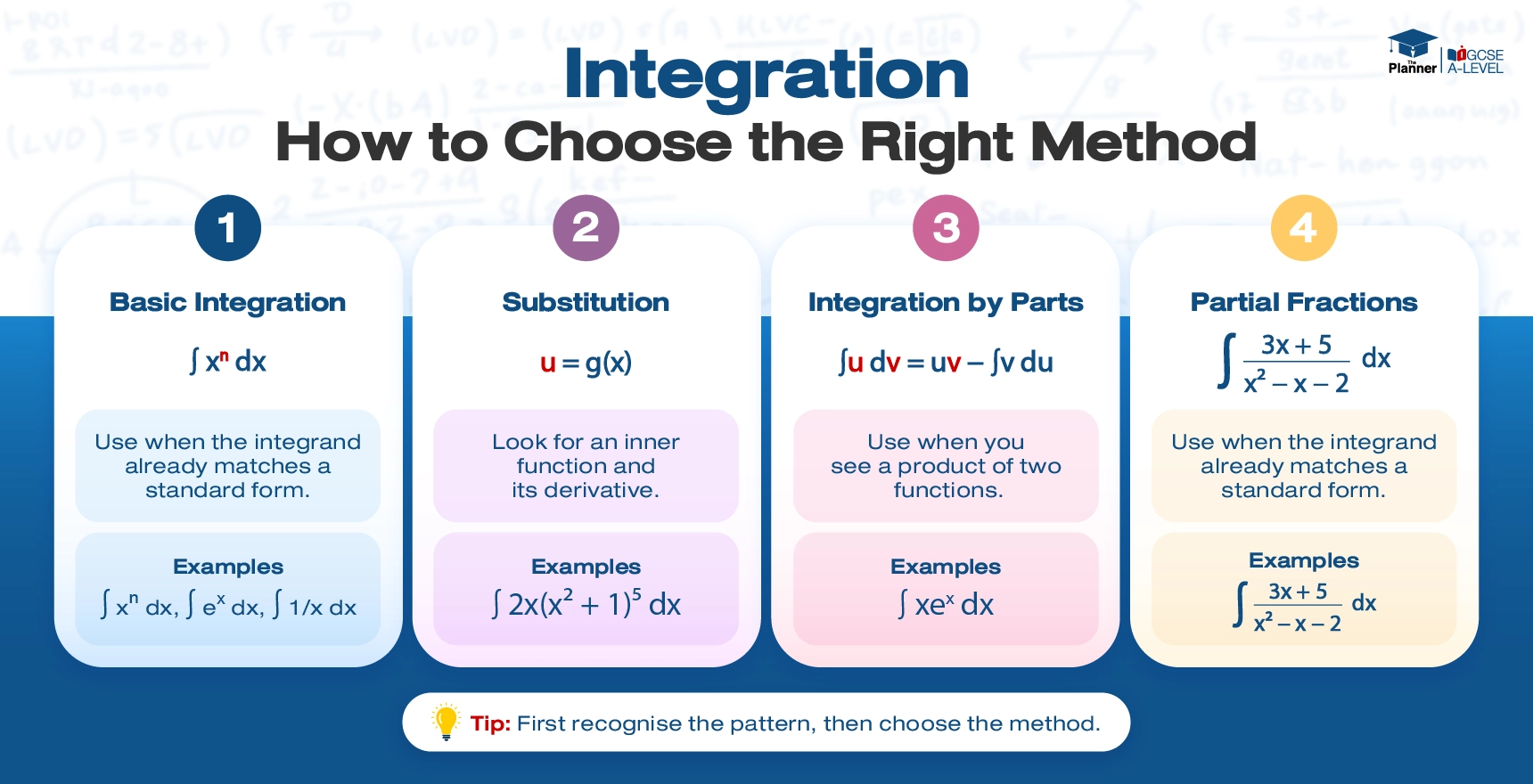
The biggest challenge is often deciding which technique to use. A question may not tell you:
“Use integration by parts.” Instead, you need to recognise the structure of the expression yourself.
This means there are really two skills involved:
Recognising the method → Applying the method accurately
Even if you understand each method separately, choosing the wrong approach can make a question much longer or prevent you from reaching the answer.
How to Improve
Rather than practising random integration questions immediately, group them by technique.
Try revising in this order:
Basic Integration → Substitution → Partial Fractions
→ Integration by Parts → Mixed Questions
Once you can identify each technique confidently, move on to mixed exam questions where the method is not given.
2. Differential Equations
Differential Equations appear in Pure Mathematics 3 and combine several skills students have already learned.
You may need to:
- form a differential equation
- separate variables
- integrate both sides
- use given conditions
- find a particular solution
- interpret the solution in context
Why Differential Equations Can Be Difficult
The difficulty often comes from the number of steps.
For example:
Separate Variables → Integrate → Add Constant → Use Initial Condition → Rearrange
If one step goes wrong, everything after it may also be affected. You therefore need a strong foundation in both Algebra and Integration before Differential Equations feel comfortable.
How to Improve
Do not begin with long modelling questions.
But to build the skill gradually:
Separation of Variables → Integration → Initial Conditions → Modelling Questions
When practising, write each stage clearly rather than trying to do several algebraic steps mentally.
3. Complex Numbers
Complex Numbers can feel unusual because they introduce a type of number that students may not have worked with before.
In Pure Mathematics 3, students work with concepts involving complex numbers and their different representations.
Why Complex Numbers Can Be Difficult
Because the topic combines both algebra and geometry.
You may need to understand expressions involving:
i² = −1
while also interpreting complex numbers on an Argand diagram.
This means a question can move between:
Algebraic Form ↔ Geometric Representation
If you only memorise algebraic procedures without understanding what a complex number represents geometrically, some questions can become difficult.
How to Improve
Learn the topic visually as well as algebraically.
Try to connect:
Real Part → Horizontal Axis
Imaginary Part → Vertical Axis
Then practise moving between equations and their geometric meaning.
4. Vectors
Vectors are included in Pure Mathematics 3 and require students to think carefully about position, direction and mathematical relationships.
Questions can involve several vectors or points at once.
Why Vectors Can Be Difficult
The arithmetic itself is often not the hardest part. The challenge is understanding what each vector represents. A small sign error can completely change the direction of a vector.
Questions may also require you to translate information from a diagram into algebra before you can begin calculating.
How to Improve
Before writing equations, identify:
Starting Point → Direction → End Point
Draw arrows when needed and keep your vector notation clear.
For longer questions, avoid skipping steps. Clear working makes it much easier to spot where a sign or direction has changed.
5. Mechanics
Mechanics is an Applied Mathematics component in Cambridge Mathematics 9709.
Its syllabus includes:
- forces and equilibrium
- kinematics of motion in a straight line
- momentum
- Newton’s laws of motion
- energy, work and power
Why Mechanics Can Be Difficult
Mechanics requires you to translate a physical situation into Mathematics.
Before solving an equation, you may need to decide:
- which forces are acting
- which direction should be positive
- whether acceleration is constant
- which motion equation is appropriate
- whether energy or momentum is the better approach
The mathematical calculation may be relatively short, but setting up the problem correctly can take much more thought.
How to Improve
For Mechanics questions, always start with the situation before the equation.
Try this structure:
Diagram → Direction → Known Values → Equation → Calculation
For forces questions, drawing a clear force diagram can prevent many sign mistakes.
6. Probability & Statistics
Depending on your A Level route, Probability & Statistics may include topics such as:
- permutations and combinations
- probability
- discrete random variables
- normal distribution
- Poisson distribution
- continuous random variables
- sampling and estimation
- hypothesis testing
Why Probability & Statistics Can Be Difficult
One of the biggest challenges is deciding which probability model applies. For example, knowing how to calculate a normal distribution probability does not help if the situation should be modelled in a different way.
Students also need to interpret wording carefully.
Words such as:
at least
at most
exactly
more than
can completely change the probability you need to calculate.
How to Improve
Before using your calculator or writing a formula, translate the question into mathematical language.
For example:
At least 3 → X ≥ 3
Fewer than 5 → X < 5
Exactly 2 → X = 2
Why Do Multi-Step A Level Maths Questions Feel Difficult?
A Level Maths questions can become challenging because one problem may test more than one topic.
For example:
Algebra → Differentiation → Stationary Point → Interpretation
or
Partial Fractions → Integration → Differential Equation
The individual techniques may not be unfamiliar. The difficulty comes from recognising how they connect. This is why students sometimes perform well on chapter exercises but struggle when completing full Past Papers.
In chapter exercises, you already know which topic you are practising. Unfortunately, in an exam, you need to identify the method yourself.
How to Improve Your A Level Maths
If you are struggling with A Level Maths, doing more questions is useful, but only if you understand why you are getting them wrong. To understand better, try this approach.
Step 1: Identify the Type of Mistake
After completing a Past Paper, separate your mistakes into:
- Concept
- Algebra
- Method selection
- Calculation
- Calculator use
- Interpretation
This gives you much more useful information than simply looking at your final score.
Step 2: Fix the Prerequisite Skill
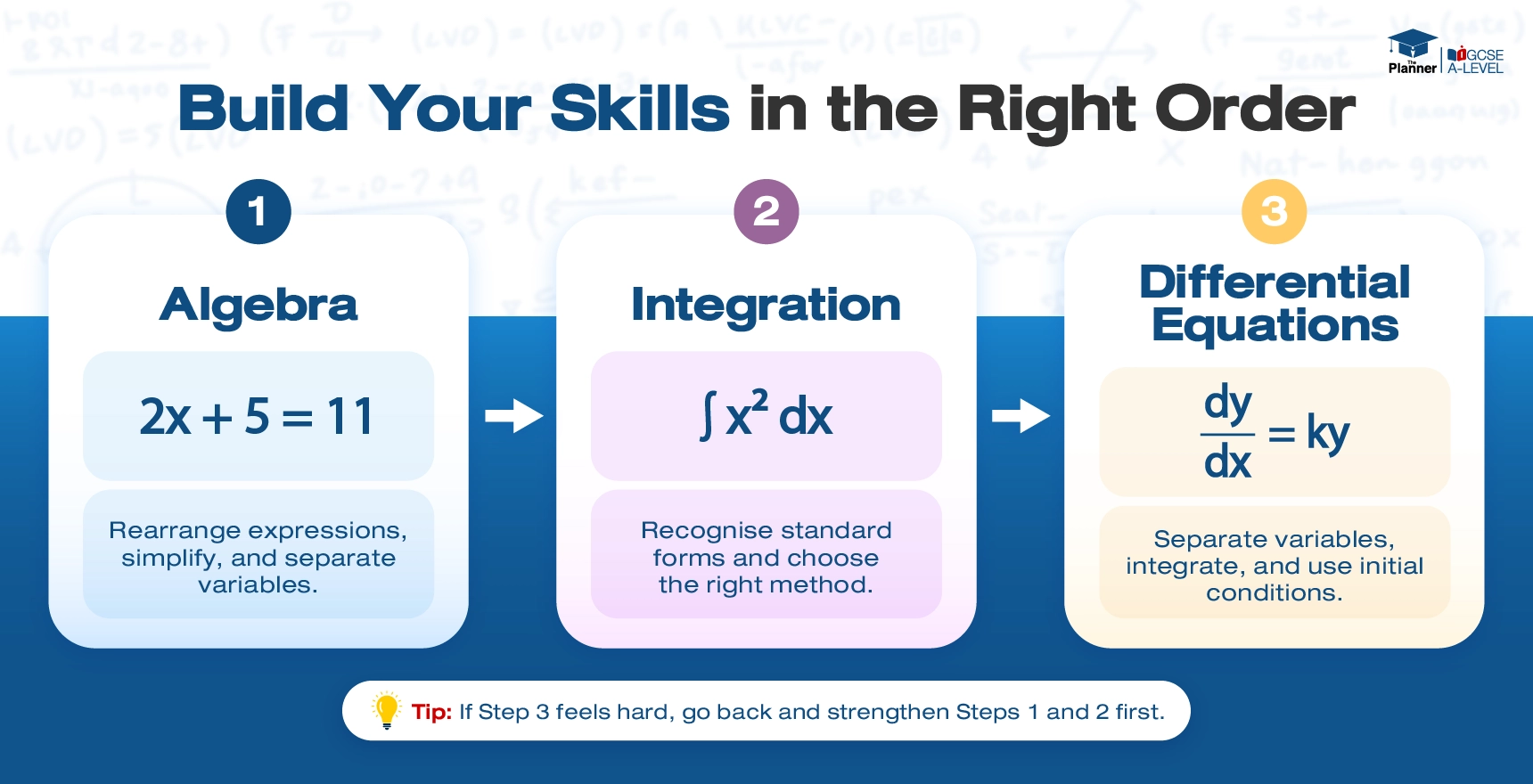
If Differential Equations are difficult because your Integration is weak, practising more Differential Equations may not solve the problem.
Try Go back one level. For example:
Algebra → Integration → Differential Equations
or
Trigonometry → Differentiation → Integration
Step 3: Practise by Topic
Once you understand the concept, complete several questions from the same topic.
Focus on recognising different variations of the question.
Step 4: Mix the Topics
Move from topic practice to mixed questions. This trains you to decide which method to use without being told the chapter.
Step 5: Complete Full Past Papers
Finally, practise full papers under timed conditions. Cambridge provides selected past question papers, examiner reports and specimen papers for Mathematics 9709. Older papers should be used carefully because Cambridge notes that they may not fully reflect the current syllabus.
If you are spending hours practising A Level Maths but still getting stuck on the same topics,
At The Planner Education, we can help identify your weak topics, rebuild the prerequisite skills and create a focused study plan for Cambridge International AS & A Level Mathematics 9709.


Should You Start With the Hardest A Level Maths Topic First?
Not necessarily because many advanced topics depend on skills from earlier chapters.
For example:
Algebra → Integration → Differential Equations
Trying to master Differential Equations while still struggling to rearrange equations or integrate expressions can make the topic feel much harder than it actually is.
Therefore, if you are really looking for an effective A Level revision plan, you need to ask yourself what skill do I need before I can understand this chapter, then the answer you are looking for will be much easier to solve.
FAQ: Hardest A Level Maths Topics
1. What is the hardest topic in A Level Maths?
Answer:
There is no single hardest topic for every student, and Cambridge does not officially rank topics by difficulty. Integration, Differential Equations, Complex Numbers and Vectors can require several connected skills, while Mechanics and Statistics may also be challenging depending on your route.
2. Is Cambridge A Level Maths difficult?
Answer:
Cambridge A Level Mathematics requires students to apply mathematical techniques, think logically, model situations and analyse results, so questions can become increasingly multi-step as the course progresses.
3. Is Pure Mathematics 3 difficult?
Answer:
Pure Mathematics 3 includes advanced topics such as Integration, Vectors, Differential Equations and Complex Numbers, so a strong foundation from earlier Pure Mathematics topics is important.
4. What topics are in A Level Pure Mathematics 3?
Answer:
Pure Mathematics 3 includes Algebra, Logarithmic and Exponential Functions, Trigonometry, Differentiation, Integration, Numerical Solution of Equations, Vectors, Differential Equations and Complex Numbers.
5. Why is A Level Integration difficult?
Answer:
Integration becomes more challenging because students need to recognise which technique to use rather than simply applying one standard method.
6. Why are Differential Equations difficult?
Answer:
Differential Equations combine several skills, including algebra, separation of variables, integration and using initial conditions.
7. Are Complex Numbers difficult?
Answer:
Complex Numbers can feel unfamiliar because students need to understand both algebraic manipulation and geometric representations such as the Argand diagram.
8. Is Mechanics difficult in A Level Maths?
Answer:
Mechanics can be challenging because students must convert a physical situation into a mathematical model before solving it.
9. Is Statistics hard in A Level Maths?
Answer:
Statistics can become difficult when students need to choose an appropriate probability model and interpret the wording of a question carefully.
10. How can I improve at A Level Maths?
Answer:
Identify where you are losing marks, fix prerequisite skills, practise individual topics, move to mixed questions and finally complete full Past Papers under timed conditions.
11. Are Past Papers enough for A Level Maths?
Answer:
Past Papers are important, but if you repeatedly make the same conceptual mistake, you should review the underlying topic before doing more full papers.
12. Where can I find official A Level Maths Past Papers?
Answer:
Selected Past Papers, Examiner Reports and Specimen Papers for Cambridge International AS & A Level Mathematics 9709 are available from Cambridge International.
References
- Cambridge International Education — Cambridge International AS & A Level Mathematics (9709)
Official subject overview and syllabus information.
- Cambridge International AS & A Level Mathematics 9709 — Syllabus 2026–2027
Official content reference for Pure Mathematics, Mechanics and Probability & Statistics.
- Cambridge International — Mathematics 9709 Past Papers, Examiner Reports and Specimen Papers
Official examination resources.