Quick Overview: Is GED a Good Choice for Thai International School Students?
- GED can be a good M.6 or high school fast-track option for Thai international school students who want a more flexible route to university, especially after IGCSE or when moving between school systems.
- GED may suit students who already have a clear university goal, know their target faculty, and are ready to prepare for other requirements such as IELTS, SAT, portfolio, or interviews.
- Before choosing GED, students should check whether their target university and faculty accept GED, what score they should aim for, and whether additional admission requirements are needed.

What Is GED?
GED, or General Educational Development, is a high school equivalency qualification recognised by Thailand’s Ministry of Education. Many Thai students and parents search for “GED เทียบวุฒิ ม.6” because they want to understand whether GED can be used as an alternative pathway before applying to university.
Many Thai international school students choose GED because they want to finish high school faster, graduate earlier, or avoid repeating a grade after returning from overseas. This is why searches like “GED เด็กอินเตอร์,” “GED เข้ามหาลัยไทย,” and “GED ใช้ยื่นมหาลัยได้ไหม” are common among students and parents.
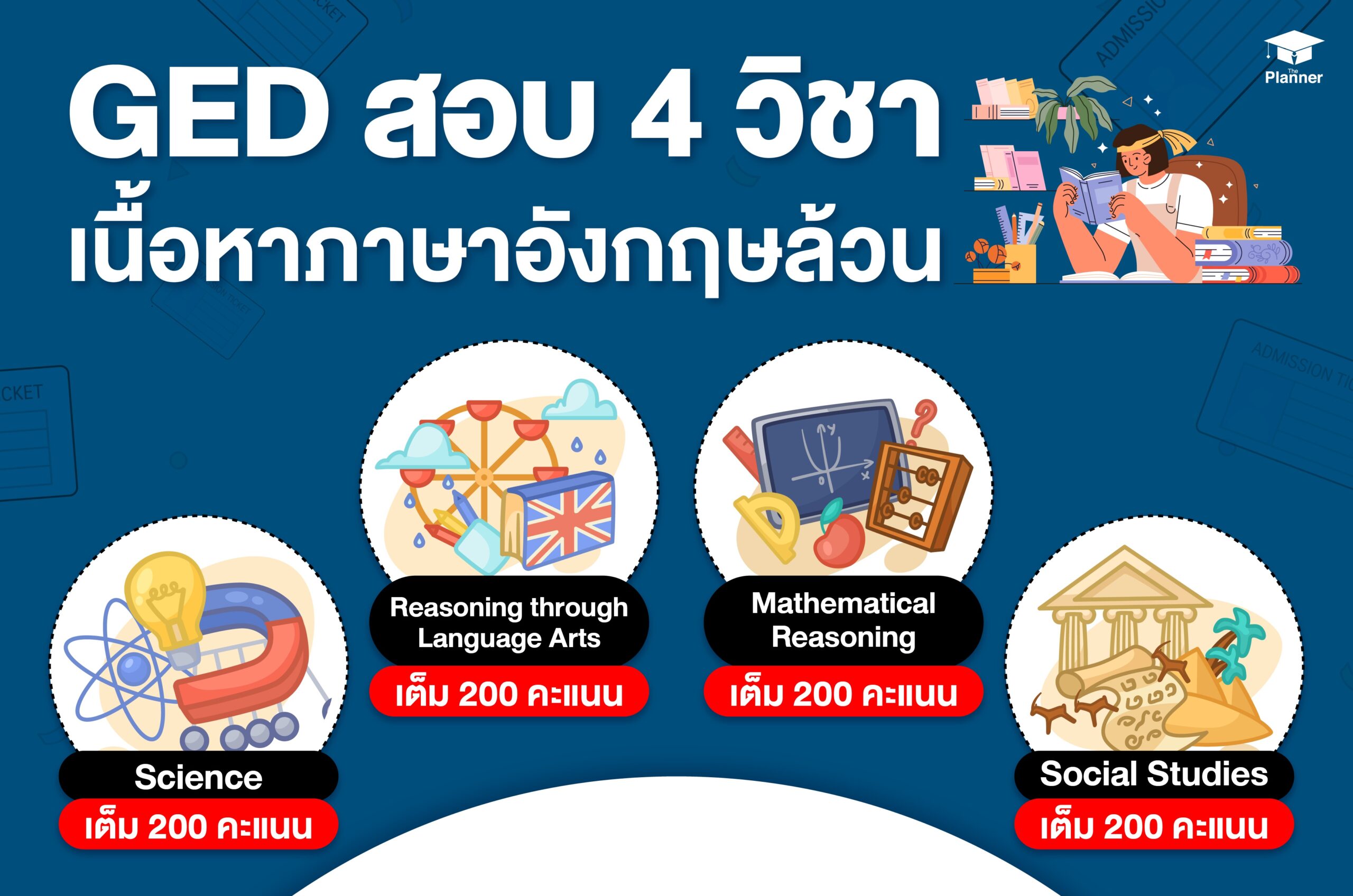
The GED test covers only four subjects: Mathematical Reasoning, Reasoning Through Language Arts, Science, and Social Studies. Students do not need another high school diploma to take GED, and use only a passport to register for approved test centers.
At The Planner Education, GED preparation can be planned intensively, and some students may be ready to complete all four subjects in one month, depending on their English level, academic foundation, and study consistency.
“The real question is not ‘How quickly can I finish GED?’ — but ‘Does GED support my future goal?'”
However, students should always check whether their target university and faculty accept GED, what score they should aim for, and whether they need additional requirements such as IELTS, SAT, portfolio, or interview preparation.
Why Thai International School Students Consider GED
Some students complete IGCSE and feel unsure whether they should continue to A-Level, IB, or Grade 12. Others may want to apply to international programs in Thai universities earlier. This is why searches like “GED เด็กอินเตอร์,” “GED เข้ามหาลัยไทย,” and “GED ใช้ยื่นมหาลัยได้ไหม” are becoming more common among Thai students and parents.
For many students, GED feels attractive because it can be faster and more flexible than a traditional school route. It may allow students to focus on other university admission requirements, such as IELTS, SAT, portfolio preparation, interview practice, or specific entrance requirements.
However, GED should not be chosen simply because it looks like the faster option. To pass on the first attempt, students still need to understand the core knowledge in each subject, as GED tests high school-level skills across Math, English, Science, and Social Studies.
Can GED Be Used for University Admission in Thailand?
GED can be used as part of a university admission pathway in Thailand, but acceptance depends on the university, faculty, program, and admission round.
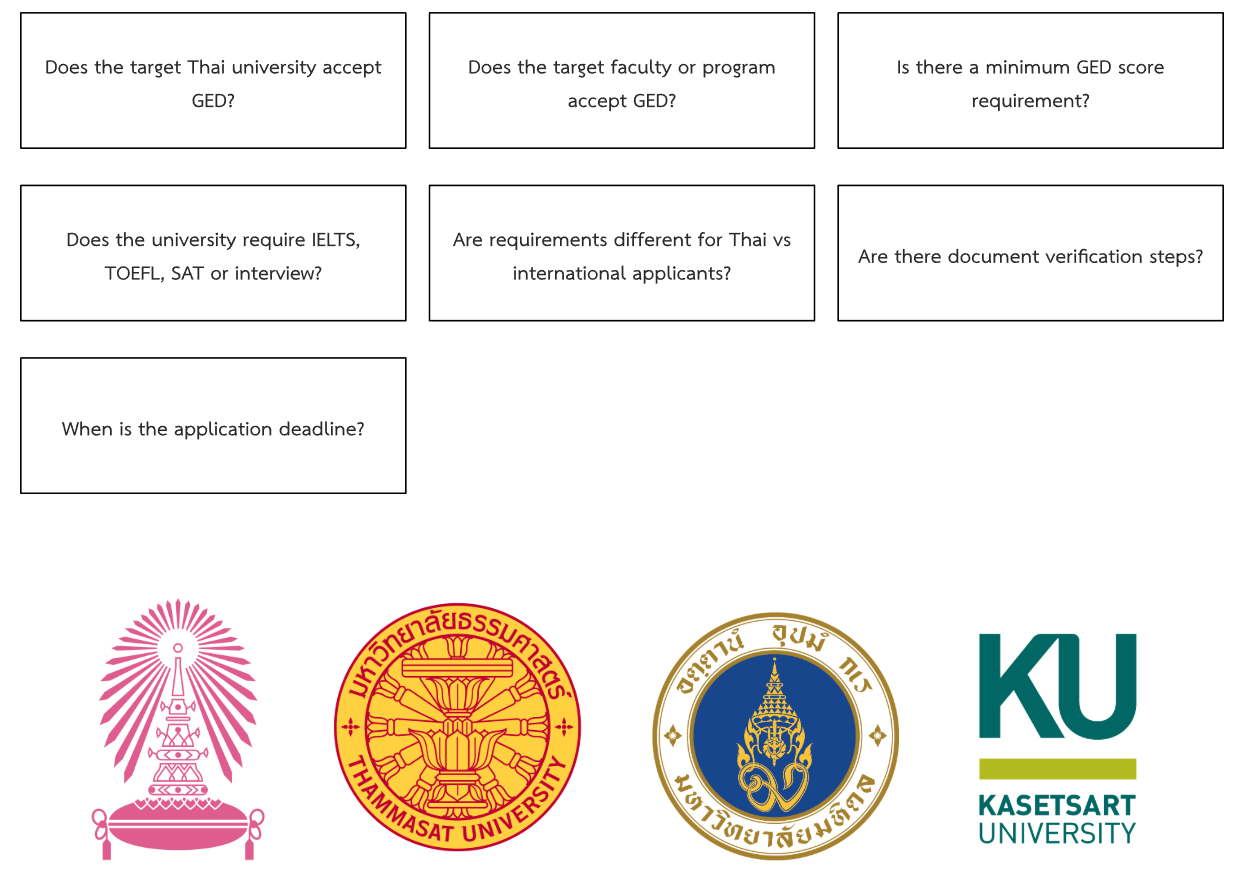
Before choosing GED, students should check:
Examples of Thai Universities That Accept GED
- Chulalongkorn University – BBA / EBA / BALAC / ISE / etc.
- Thammasat University – BBA / BE / TEP-TEPE / SIIT / etc.
- Mahidol University International College – BBA / CommDe / etc.
- Kasetsat University – BBA / EEBA / BEcon / IUP / etc.
GED vs IGCSE vs A-Level: How to Decide?
Many Thai students search for “GED vs IGCSE” because they want to know which option is better. The answer depends on the student’s objective.
IGCSE is usually part of a longer international school pathway consisting of two years. After IGCSE, students may continue to A-Level, IB, or Grade 12. This pathway may be better for students who want more academic structure or need subject depth for competitive programs.
GED is a high school equivalency route. It may be suitable for students who want a faster and more flexible pathway, especially if they already know their target university and faculty.
GED – Fast Track |
IGCSE / AS/A-Level – Academic |
| ✅ Flexible timeline, finish in ~1 month ✅ Good if target university accepts GED ✅ Focus on IELTS/SAT/portfolio earlier ❌ No deep subject specialisation ❌ Not accepted by all competitive programs ❌ Not ideal if unsure about faculty |
✅ Strong academic structure and depth ✅ Better for competitive / overseas programs ✅ Required by some faculties (Medicine, Eng) ❌ Longer timeline (1–2 years) ❌ Less flexible for mid-system switchersBetter if unsure about faculty direction |
So, If you are choosing between GED, IGCSE, or GCE A-Level, the question should not simply be “Is GED better than IGCSE?” but “Which pathway best supports my university plan?”
GED vs AS/A-Level: High School Diplomas That Serve Different Purposes?
GED is usually chosen as a faster and more flexible high school equivalency way. AS/A-Level is a deeper academic route where students specialise in specific subjects such as Mathematics, Physics, Chemistry, Biology, Economics, Business, or Psychology.
For students who are aiming for Business, Communication, Arts, or some international programs in Thailand, GED may be a suitable option if the target university accepts it and the rest of the application is strong.
For students aiming for Medicine, Engineering, Science, Economics, or highly competitive Thai or overseas universities, AS/A-Level or another subject-based qualification may sometimes be more appropriate.
This does not mean GED is better or worse than AS/A-Level. It means the right choice depends on the student’s destination.
Common Mistakes Thai Students Make with GED
❌ Choosing GED because it seems faster
GED can be faster than a traditional school since students can graduate with only one month of preparation, but faster does not always mean better. Students should make sure the GED leads to the university and faculty they actually want.
❌ Checking university requirements too late
Students should check university and faculty requirements before preparing for GED, not after finishing the exam. Each university may set different GED score requirements. Some programs may only require the minimum passing score, which is 145 per subject or 580 in total, while others may require a higher total score, such as 600–660, or a minimum score of 165 in each subject. Therefore, students who decide to take GED should understand the requirements of their target university before planning their exam.
❌ Taking GED alone is enough
Many Thai universities require more than GED. Students may also need to submit IELTS, SAT, or ACT scores, as well as portfolios, depending on the university and faculty they are applying to. This is why students should plan their preparation carefully.
At The Planner Education, we may recommend students to complete GED first, especially if they want to secure their high school equivalency qualification early. Since GED preparation can often be completed within around one month, this gives students more peace of mind before moving on to other requirements such as SAT, IELTS, or portfolio preparation. However, the order can also be adjusted depending on each student’s timeline, goals, and personal preferences.
❌ Only aiming for the minimum score
While meeting the minimum score may be enough for some programs, students should still set a target score based on their university goal, faculty requirements, and the competitiveness of the program they are applying to.
How The Planner Helps Students Study GED
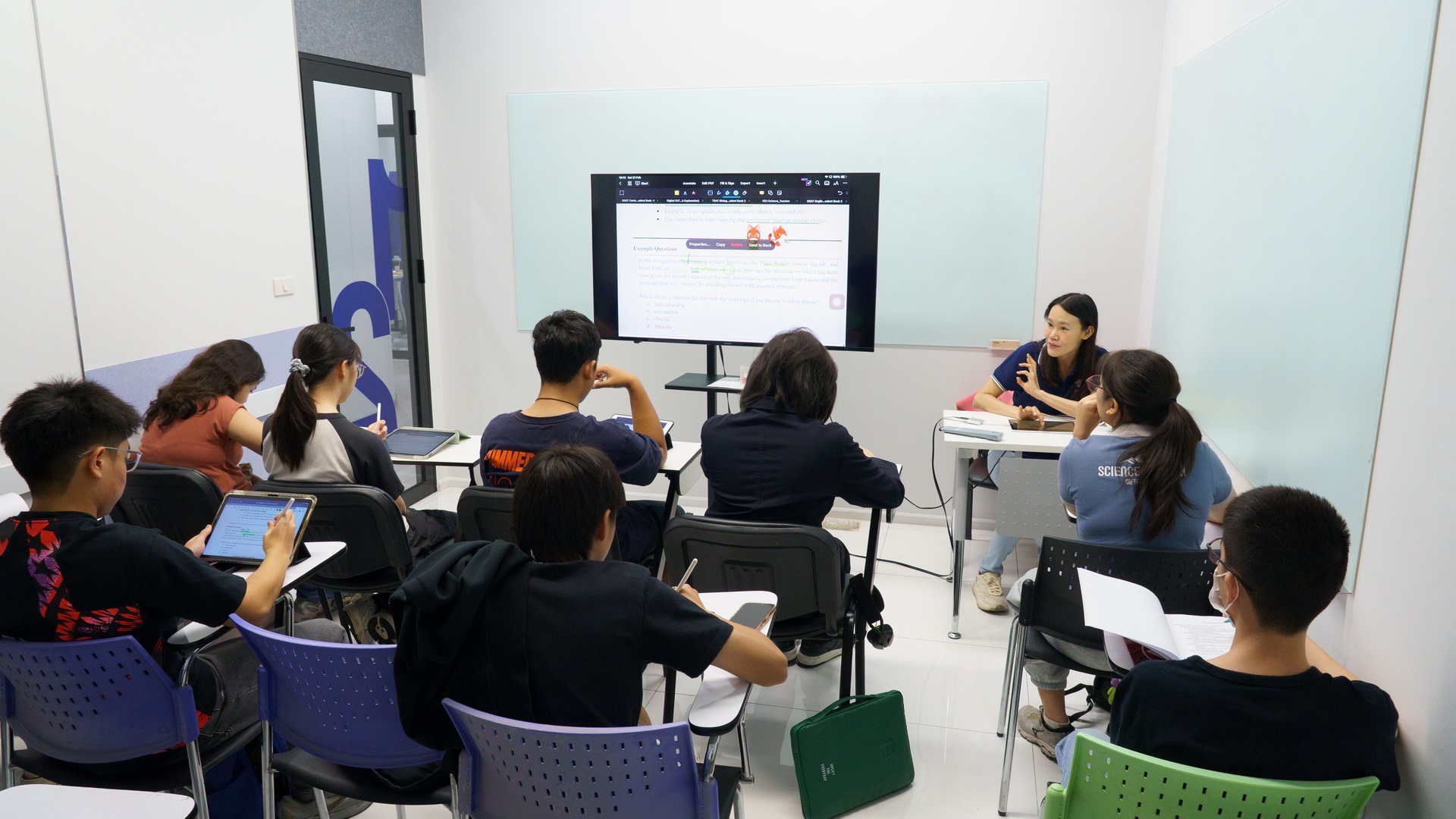

- Free GED Mock Test valued at 3,000 THB to evaluate each student’s current level before starting
- Close academic support and progress tracking throughout the course
- Updated GED exam-style questions based on recent test
- Complete coverage of all four GED subjects: Math, RLA, Science, and Social Studies
- Result-guaranteed GED course with free course retake if students do not pass, according to course conditions
- Support with GED exam registration and high school equivalency planning
- University pathway consultation based on each student’s target university, faculty, and timeline
- Guidance for students who are still unsure which university or faculty to choose
- Flexible class options: On-site, Online, Group, and Private classes
FAQ: Common Questions Thai Students Ask About GED
Q: Can Thai international school students take GED?
A: Yes. Many Thai international school students consider GED as an alternative high school equivalency route, especially if they want a faster or more flexible pathway.
Q: Can GED be used for university admission in Thailand?
A: GED may be accepted by some universities and international programs in Thailand, but requirements vary by university and faculty. Students should always check directly with their target program.
Q: Is GED better than IGCSE or A-Level?
A: Not always. GED may be faster, while IGCSE and A-Level may provide more academic structure and subject depth. The best option depends on the student’s university goal.
Q: Who should consider GED?
A: GED may suit students who have a clear university target, want a fast-track route, and are ready to prepare other requirements such as IELTS, SAT, portfolio, or interview.
Q: Does Chulalongkorn University accept GED?
A: Yes, Chulalongkorn University accepts GED for some programs, especially international programs, but GED alone is usually not enough to apply. Students who use GED must request a High School Equivalence Certificate from Chulalongkorn University Academic Testing Center (ATC) or the HSCES system before applying.
Each faculty or international program may have different requirements. For example, some programs may also require IELTS, TOEFL, SAT, CU-AAT, portfolio, interview, or other subject-specific scores. So, before applying, students should always check the latest admission requirements of the specific Chula program they want to enter.
Q: What GED score do you need for Chulalongkorn University?
A: For GED to be considered as a high school equivalency qualification, students generally need to pass all 4 GED subjects with at least 145 points in each subject. However, getting 145+ on GED does not automatically mean you will be accepted into Chulalongkorn University.
Most Chula programs require additional scores. For example, international programs may ask for English proficiency tests such as IELTS, TOEFL, or CU-TEP, and aptitude tests such as SAT or CU-AAT. Competitive programs may also consider higher scores, interviews, portfolios, and the number of available seats.
In short, GED is mainly the high school qualification part. To increase your chance of getting into Chula, you should prepare the other required admission scores as well.
Q: Is GED hard for Thai students?
A: GED can be challenging for Thai students, especially for students who are not used to studying academic subjects in English. The test covers 4 subjects: Mathematical Reasoning, Reasoning Through Language Arts, Science, and Social Studies.
For many Thai students, the most difficult parts are usually English reading, academic vocabulary, essay writing, and interpreting long questions in Science or Social Studies. Math may feel easier for students with a strong foundation, but the questions are still written in English and require problem-solving skills.
GED is not impossible, but students should not treat it as an “easy shortcut.” With the right study plan, practice tests, vocabulary preparation, and clear target score, Thai students can pass GED and use it for university admission.
Q: Can I study abroad with a GED?
A: Yes, GED can be used to apply to many universities abroad. GED is widely recognized as a high school equivalency qualification, especially in the United States and many international universities around the world.
However, every university has its own admission policy. Some universities may accept GED as a high school qualification, while others may also require SAT, ACT, IELTS, TOEFL, foundation year, portfolio, or subject-specific requirements.
If you plan to study abroad with GED, the best approach is to check the admission page of each university and country carefully. GED can open the door, but strong English scores, academic preparation, and a clear university plan will help make the application stronger.