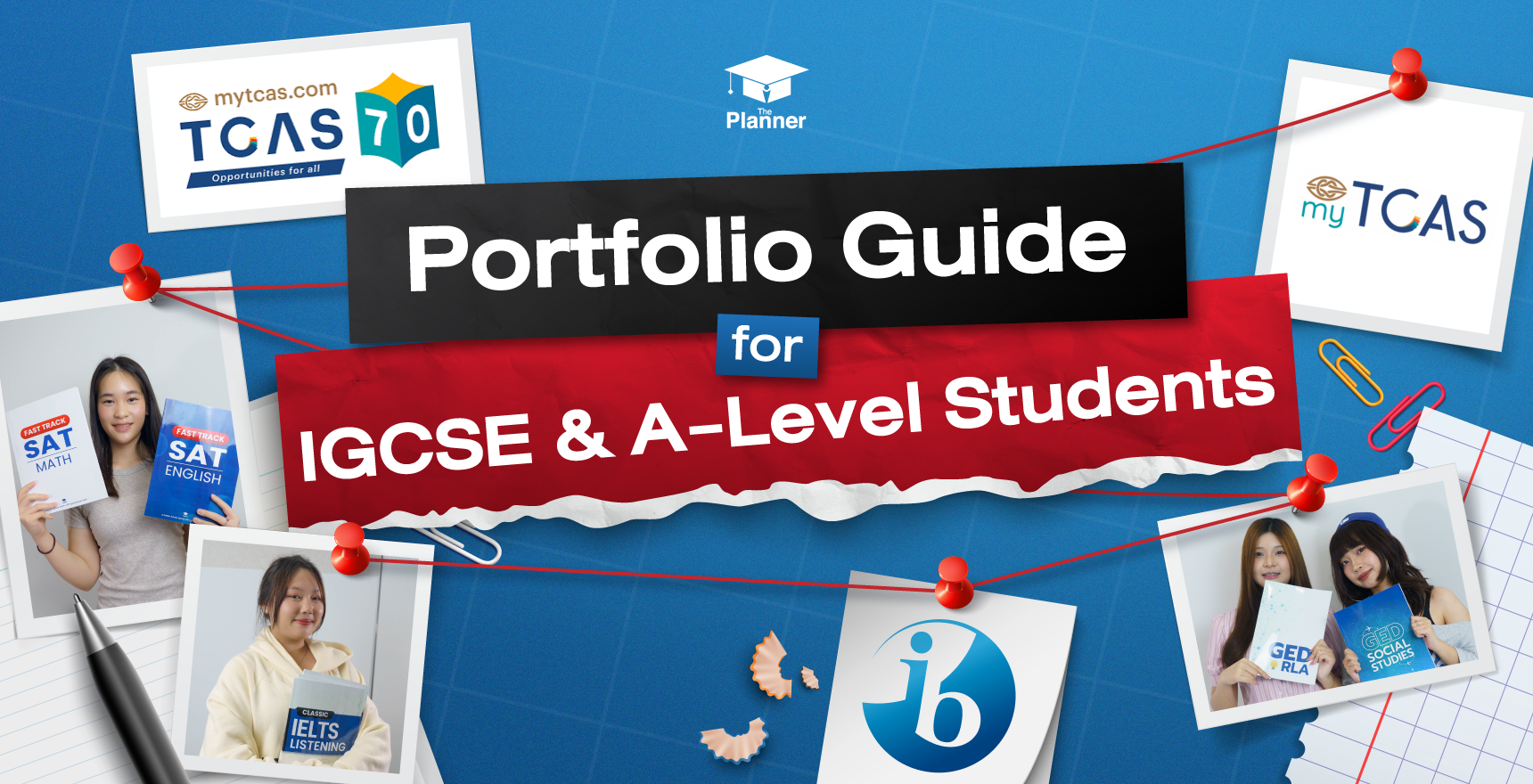
Quick Overview : TCAS70 Portfolio Guide: How IGCSE & A-Level Students Can Prepare for Round 1
- The TCAS Portfolio Round (TCAS Round 1) is the first round of Thai university admissions. It uses academic results, a portfolio, and supporting documents instead of Thai-language entrance exams.
- It’s a natural fit for students with IGCSE, A-Level, GED, and test scores like SAT, IELTS, ACT, or TOEFL.
- Universities aren’t looking for perfection — they’re looking for clear, consistent academic direction.
- Planning should ideally start during IGCSE Year 10–11 or the A-Level AS year.
- For TCAS70, students should check the TCASFolio system on the official MyTCAS website.
– What Is the TCAS Portfolio Round? (TCAS Round 1 Explained) ▶
– Why IGCSE & A-Level Students Often Choose the TCAS Portfolio Round ▶
– TCAS Portfolio Planning: Why Direction Matters More Than Perfection ▶
– Choosing IGCSE & A-Level Subjects That Support Your Portfolio ▶
– Building a Strong but Honest TCAS Portfolio ▶
– Common TCAS Portfolio Mistakes to Avoid ▶
– TCAS 69–70: What International Programme Students Should Expect ▶
– Finding an IGCSE & A-Level Tutor for TCAS Portfolio Preparation ▶
– FAQ: Common Questions Thai Students Ask About TCAS Portfolio ▶
What Is the TCAS Portfolio Round? (TCAS Round 1 Explained)
In the Thai university admission system, the TCAS portfolio round refers to Round 1 of TCAS, which is the first of four admission rounds. This round allows students to apply using their academic results and supporting documents, without taking Thai-language centralised entrance examinations.
Applicants may submit:
- High school transcripts (Grade 12) IGCSE, A-Level, or GED results
- International test scores such as SAT, IELTS, ACT, or TOEFL (depending on faculty requirements)
In addition to academic results, universities may also consider portfolios, personal statements, and interviews as part of the selection process. Rather than focusing on Thai written entrance exams, this round evaluates whether a student’s academic background matches the programme they are applying for.
Official information and updates can be found on the MyTCAS website: https://www.mytcas.com/
Why IGCSE & A-Level Students Often Choose the TCAS Portfolio Round
Many Thai students who study IGCSE, A-Level, or attend international programme schools choose to apply through the TCAS Portfolio Round. This is because their academic background already involves studying and being assessed in English, including qualifications such as IGCSE, A-Level, SAT, or IELTS.
As a result, the TCAS Portfolio Round often allows these students to present their academic strengths more naturally, without relying solely on Thai-language entrance examinations (for international university applications). For students from international schools, this pathway feels familiar and aligned with how they have been learning throughout secondary school.
TCAS Portfolio Planning: Why Direction Matters More Than Perfection
A common misconception is that students need perfect grades or an outstanding list of activities to succeed in the TCAS Portfolio Round. In practice, universities are often looking for clear academic direction, subject relevance, and consistency over time.
Early planning helps students:
- Choose subjects that align with their intended faculty
- Understand which scores or documents are required
- Avoid last-minute stress during the application period
Students who begin planning during IGCSE Year 10–11 or A-Level AS year usually feel more confident when the portfolio submission period arrives.
Choosing IGCSE & A-Level Subjects That Support Your Portfolio
Subject selection is a key part of TCAS portfolio preparation. Universities often consider whether a student’s subject choices match the academic demands of the programme.
| Faculty Group | Recommended Subjects |
|---|---|
| Engineering / Science | Mathematics, Physics, Chemistry |
| Business / Economics | Mathematics, Economics, Business Studies |
| Arts / Social Sciences | English, History, Global Perspectives |
Choosing subjects based on interest and faculty relevance helps universities understand a student’s academic direction more clearly.
Building a Strong but Honest TCAS Portfolio
A strong portfolio does not need to include many certificates or competitions. Instead, it should clearly show:
- Academic background and subject choices
- Relevant activities or experiences
- Personal interest in the chosen field
Universities understand that students are still exploring their interests. Honest explanations and logical connections are often more effective than exaggerated achievements.
Common TCAS Portfolio Mistakes to Avoid
Students may struggle in the TCAS portfolio round when they:
- Choose subjects without checking faculty requirements
- Submit the same portfolio to multiple unrelated faculties
- Write personal statements without clear motivation
- Feel unprepared for interviews
Most of these issues can be avoided with early planning and proper guidance.
TCAS 70: What International Programme Students Should Expect
For TCAS 70, competition is expected to remain high in many programmes. While academic results are important, universities also look for students who:
- Understand their academic pathway
- Can explain their subject choices clearly
- Show consistent effort over time
Good preparation does not require starting over — it requires organising what you already have.
Finding an IGCSE & A-Level Tutor for TCAS Round 1
Preparing for the TCAS portfolio round (TCAS70) does not require students to be perfect, but having the right academic guidance can make the process clearer and more structured. An experienced IGCSE and A-Level tutor can help students plan subject choices, strengthen academic foundations, and prepare portfolios that align with faculty expectations.
At The Planner Education, academic planning focuses on helping students understand requirements early, reduce unnecessary score deductions, and present their academic background clearly. With personalised support, students can approach the TCAS portfolio round with greater confidence and direction.
FAQ: Common Questions Thai Students Ask About TCAS Portfolio
Q: What is the TCAS Portfolio Round?
A: The TCAS Portfolio Round, also known as TCAS Round 1, is the first round of Thai university admissions. Students apply using academic records, portfolios, personal statements, interviews, and supporting documents rather than Thai-language centralised entrance exams. It’s commonly chosen by students from international schools or English-based programmes.
Q: Is TCAS Portfolio suitable for IGCSE and AS/A-Level students?
A: Yes. Many programmes accept international qualifications as part of the application. Students can use their academic results, subject choices, English test scores, and relevant activities to show readiness. However, students should check whether they need to complete Chulalongkorn University’s high school equivalency verification before applying.
Q: How important are IGCSE and AS/A-Level for the TCAS portfolio round?
A: Very important. They provide academic evidence for students from international or English-based programmes. Universities use these qualifications to assess academic readiness, subject relevance, consistency, and whether the student’s background matches the chosen faculty.
Q: When should students start planning for IGCSE or AS/A-Level?
A: Ideally during IGCSE Year 10–11 or the A-Level AS year. Early planning helps students choose the right subjects, understand faculty requirements, prepare required test scores, improve weaker areas, and avoid last-minute pressure.
Q: Which AS/A-Level subjects matter most for portfolio applications?
A: It depends on the faculty. Engineering and science programmes usually value Mathematics, Physics, and Chemistry. Business or economics programmes look for Mathematics, Economics, or Business Studies. Arts and social science programmes tend to focus on English, History, or essay-based subjects.
Q: Will weak IGCSE results affect A-Level applications?
A: They may, especially for universities that consider GCSE/IGCSE grades as part of minimum entry requirements or scholarship review — for example, LSE, UCL, and the University of Nottingham Ningbo China. However, strong AS/A-Level results, relevant subject choices, and a clear upward academic trend can still strengthen the overall application.
Q: Do students need SAT, IELTS, ACT, or TOEFL for TCAS Portfolio?
A: It depends on the university and faculty. Some programmes require English proficiency scores such as IELTS, TOEFL, or Duolingo English Test, while others ask for aptitude scores like SAT or ACT. Always check the latest official requirements from each programme.
Q: What makes a strong TCAS portfolio?
A: A strong portfolio clearly presents academic background, subject choices, relevant activities, and genuine interest in the chosen field. It doesn’t need every certificate or achievement — what matters is a clear, honest, and logical story about the student’s academic direction and readiness.
For TCAS70, students should also check the latest TCASFolio guidelines on the official MyTCAS website. TCASFolio is a central digital portfolio system that lets applicants organise academic records, essays, recommendations, projects, activities, certificates, awards, and university-specific questions in a standardised format. Applicants can then download the portfolio as a PDF or share a portfolio link, depending on each university’s requirements.